1. Google Ads E-commerce Hardware Store (Canada)
A hardware e-commerce store had the products, market demand, and growth potential, but its advertising performance was inconsistent. We rebuilt the paid growth system with stronger tracking, cleaner campaign structure, better product-level insights, and conversion-focused website improvements.
The Business Situation
The client was operating in a competitive hardware category where customers compare price, availability, delivery timelines, and trust before placing an order. Their website was receiving traffic, but the paid ads account did not clearly show which campaigns were responsible for profitable sales.
Ad spend was being used across multiple products and campaign types, but there was limited clarity on where the strongest buying intent existed. This made scaling risky because increasing the budget could also increase wasted spend if the account structure was not corrected first.
Our first priority was to create a reliable performance foundation: accurate tracking, cleaner data, structured campaigns, and a website journey that supported conversion instead of slowing it down.
Key Problems Identified
- Campaigns were not clearly separated by product intent, search behaviour, or purchase readiness.
- Budget was being spent on traffic that did not always lead to measurable revenue.
- Purchase tracking needed better validation so campaign decisions could be trusted.
- Product pages needed stronger clarity, trust elements, and a smoother path to checkout.
- There was no consistent system for deciding which products deserved more budget.
- The account needed a controlled scaling plan instead of broad budget increases.
Our Growth Process
Performance Audit and Tracking Review
We began by auditing the Google Ads account, conversion actions, product feed, search terms, landing pages, and checkout journey. The goal was to identify where performance data was unclear and where budget was being spent without enough commercial return.
This helped us separate real growth opportunities from surface-level traffic numbers. Instead of looking only at clicks or impressions, we focused on purchases, revenue, cost per acquisition, and ROAS.
Campaign Structure Rebuild
We rebuilt the campaign structure across Search, Shopping, and Performance Max so each campaign had a clearer role. Search campaigns were aligned with high-intent queries, Shopping campaigns were refined around product visibility, and Performance Max was monitored with stronger product and audience signals.
This structure made it easier to control budgets, compare performance, and understand which parts of the account were actually contributing to sales.
Search Intent and Product-Level Optimization
We reviewed search terms, product performance, and buying patterns to identify where customers showed the strongest purchase intent. Products with better conversion potential received more attention, while irrelevant searches and low-performing areas were reduced.
This improved budget efficiency because spend was redirected toward products and keywords that were more likely to produce revenue.
Website and Conversion Rate Optimization
Paid traffic can only perform when the website experience supports the sale. We reviewed product page clarity, navigation, trust signals, checkout flow, and mobile usability to remove friction from the buying journey.
The focus was to make it easier for visitors to understand the product, trust the store, and complete the purchase without unnecessary steps or confusion.
Budget Scaling With ROAS Control
Once the account started showing clearer profitable patterns, we scaled budgets gradually. We did not scale every campaign equally. Budget increases were based on purchase volume, revenue contribution, conversion quality, and return on ad spend.
This helped the client grow sales while maintaining control over profitability and reducing the risk of overspending on weak traffic.
Execution Focus
The project was handled as a complete performance system rather than a simple ad campaign setup. We connected campaign decisions with website behaviour, product performance, and actual sales outcomes.
Every optimization was reviewed through a commercial lens: whether it helped reduce wasted spend, improve conversion quality, increase profitable purchases, or make scaling more predictable.
What Changed for the Client
- The client gained better clarity on which campaigns and products were driving revenue.
- Budget allocation became more strategic instead of being spread too broadly.
- The website journey became more aligned with paid traffic expectations.
- Campaign performance became easier to measure, manage, and improve over time.
- The business had a stronger foundation for future scaling across paid channels.
From inconsistent ad performance to a measurable revenue system.
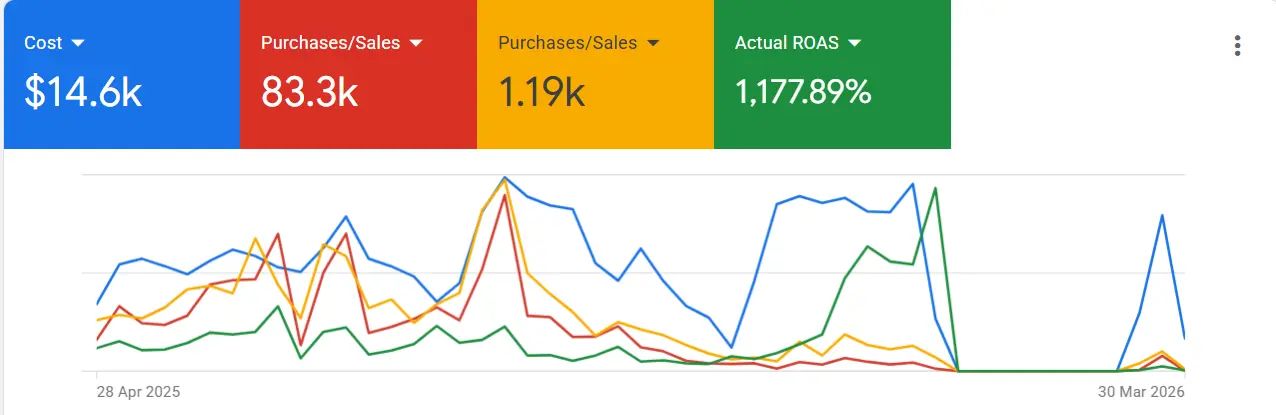
The campaign generated $83.3K in sales from $14.6K in ad spend, with 1.19K purchases tracked and an 11.77x ROAS. More importantly, the client gained a clearer system for understanding performance and making smarter growth decisions.
The work created a stronger paid acquisition foundation: better tracking, better budget control, stronger conversion paths, and a scalable approach to increasing revenue without relying on guesswork.
Ready to build a growth system like this for your business?
Get Similar Results2. Google Ads E-commerce - Beauty & Cosmetics(India)
A beauty and cosmetics brand had a strong product catalogue and growing online demand, but needed a more dependable paid acquisition system to turn that demand into profitable, measurable sales. We refined the Google Ads strategy with stronger tracking, audience signals, product-level optimisation, and a conversion-focused shopping journey.
The Business Situation
The client operates in the highly competitive beauty and cosmetics market, where shoppers compare ingredients, product benefits, reviews, offers, and delivery confidence before buying. The brand was attracting traffic, but needed clearer visibility into which campaigns and products were creating valuable conversions.
Spend was spread across a broad catalogue and multiple campaign types, while purchase intent varied by product, concern, and audience. Scaling without a more controlled structure risked investing further in low-value traffic instead of the products and searches most likely to convert.
Our priority was to build a reliable performance foundation: accurate conversion tracking, cleaner data, structured campaigns, and product pages that made the route from discovery to checkout feel effortless.
Key Problems Identified
- Campaigns needed clearer separation by beauty category, shopper intent, and purchase readiness.
- Budget was reaching audiences that did not consistently translate into valuable conversions.
- Conversion tracking needed validation so optimisation decisions could be trusted.
- Product pages needed sharper benefit communication, social proof, and an easier route to checkout.
- There was no consistent framework for deciding which SKUs and collections deserved more budget.
- The account required controlled scaling rather than broad budget increases across every campaign.
Our Growth Process
Performance Audit and Tracking Review
We began by auditing the Google Ads account, conversion actions, product feed, search terms, landing pages, and checkout journey. The objective was to identify unclear performance data and spending that was not generating enough commercial value.
This helped us separate real growth opportunities from surface-level traffic numbers. Instead of looking only at clicks or impressions, we focused on conversions, conversion value, cost per acquisition, and ROAS.
Campaign Structure Rebuild
We rebuilt the campaign structure across Search, Shopping, and Performance Max so each campaign had a clearer role. Search campaigns aligned with high-intent beauty queries, Shopping focused on relevant product visibility, and Performance Max used stronger product and audience signals.
This structure made it easier to control budgets, compare performance, and understand which parts of the account were actually contributing to sales.
Search Intent and Product-Level Optimization
We reviewed search terms, product performance, and buying patterns to identify where shoppers showed the strongest purchase intent. High-potential beauty products and collections received more attention, while irrelevant searches and low-performing areas were reduced.
This improved budget efficiency because spend was redirected toward products and keywords that were more likely to produce revenue.
Website and Conversion Rate Optimization
Paid traffic performs best when the website supports the sale. We reviewed product benefits, ingredient information, reviews, navigation, checkout flow, and mobile usability to remove friction from the buying journey.
The focus was to make it easier for visitors to understand the product, trust the brand, and complete the purchase without unnecessary steps or confusion.
Budget Scaling With ROAS Control
Once the account showed clearer profitable patterns, we scaled budgets gradually. We did not scale every campaign equally. Budget increases were based on conversion volume, conversion value, audience quality, and return on ad spend.
This helped the brand grow conversion value while maintaining control over profitability and reducing the risk of overspending on weak traffic.
Execution Focus
The project was handled as a complete performance system rather than a simple ad campaign setup. We connected campaign decisions with website behaviour, product performance, and valuable conversion outcomes.
Every optimisation was reviewed through a commercial lens: whether it helped reduce wasted spend, improve conversion quality, increase high-value actions, or make scaling more predictable.
What Changed for the Client
- The brand gained better clarity on which campaigns, audiences, and products were driving conversion value.
- Budget allocation became more strategic instead of being spread too broadly.
- The website journey became more aligned with beauty shoppers' research and purchase expectations.
- Campaign performance became easier to measure, manage, and improve over time.
- The business gained a stronger foundation for future scaling across paid channels.
From fragmented ad activity to a scalable beauty e-commerce growth system.
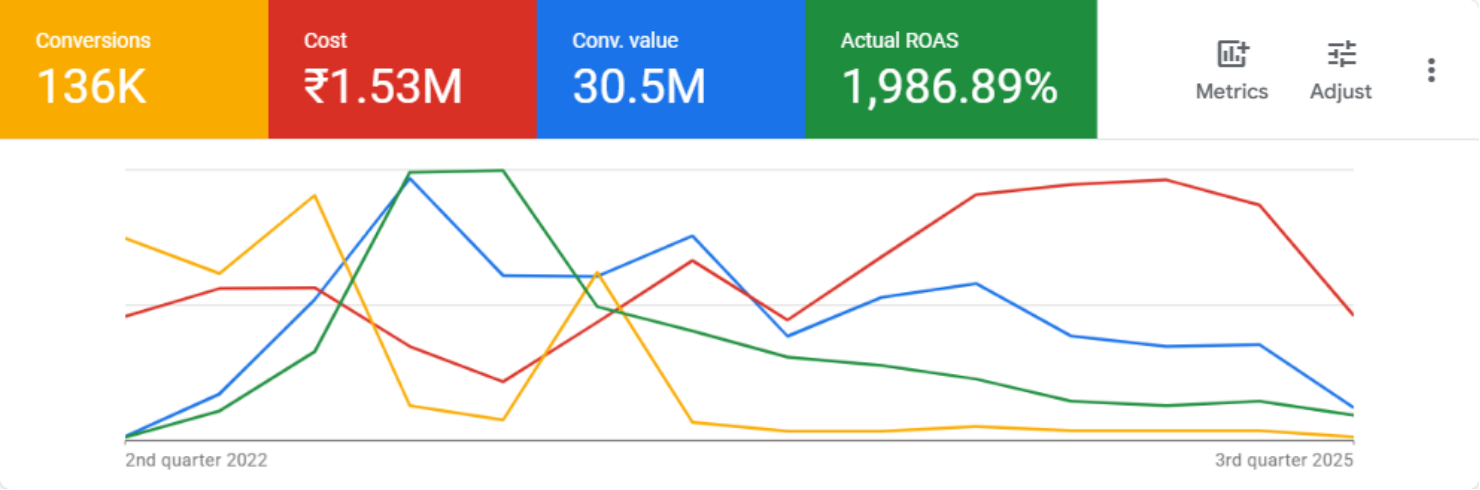
The campaign delivered ₹30.5M in conversion value from ₹1.53M in ad spend, with 136K conversions tracked and an actual ROAS of 1,986.89%. More importantly, the brand gained a clearer system for understanding performance and making smarter growth decisions.
The work created a stronger paid acquisition foundation: better tracking, tighter budget control, stronger product-to-checkout journeys, and a scalable approach to increasing conversion value without relying on guesswork.
Ready to build a growth system like this for your business?
Get Similar Results3. Facebook Ads Lead Generation - Real Estate (UK)
The business needed a predictable way to generate qualified enquiries at scale through Meta. We built a clearer Facebook and Instagram lead-generation system, combining stronger campaign structure, creative testing, audience refinement, and lead-quality reporting to turn reach into measurable opportunities.
The Business Situation
The client was operating in a competitive lead-generation market where prospects need repeated, relevant messages before they are ready to enquire. The account had delivery potential, but needed a clearer system for connecting Facebook and Instagram activity with a steady flow of measurable Meta leads.
Budget was spread across multiple campaigns and audiences, while lead intent varied significantly. Scaling without a more controlled structure risked spending more on attention that did not translate into qualified enquiries or a sustainable cost per lead.
Our priority was to create a reliable acquisition foundation: accurate lead tracking, clearer campaign roles, audience learning, compelling creative, and a low-friction path from ad engagement to form submission.
Key Problems Identified
- Campaigns needed clearer separation by prospecting, retargeting, offer, and audience temperature.
- Budget was reaching people who did not consistently progress to a lead submission.
- Lead tracking and reporting needed validation so optimisation decisions could be trusted.
- Creative needed clearer value propositions, stronger hooks, and messages built for mobile attention.
- There was no consistent framework for comparing audiences, placements, and creative performance.
- The account needed controlled scaling rather than broad increases across every ad set.
Our Growth Process
Performance Audit and Tracking Review
We began by auditing the Meta Ads account, lead events, campaign objectives, audiences, placements, creative, forms, and landing-page journey. The objective was to identify unclear performance data and spending that was not producing enough valuable lead activity.
This helped us separate real growth opportunities from surface-level traffic numbers. Instead of looking only at clicks or impressions, we focused on leads, cost per lead, lead quality, frequency, and scale.
Campaign and Audience Structure Rebuild
We rebuilt the account across clear prospecting, retargeting, and testing layers so every campaign had a defined role. Broad and interest-based audiences were managed alongside warm-engagement groups, while budget was directed towards the combinations creating efficient lead volume.
This structure made it easier to control budgets, compare performance, and understand which parts of the account were actually contributing to leads.
Creative and Message Testing
We tested creative angles, opening hooks, formats, calls to action, and proof points to identify the messages that encouraged prospects to stop, engage, and submit an enquiry. Winning concepts were refined while fatigued or weak creative was replaced.
This improved budget efficiency because spend was redirected toward messages and audiences more likely to produce leads at a sustainable cost.
Lead Form and Conversion Journey Optimisation
Paid social works best when the conversion experience makes responding easy. We reviewed lead-form flow, landing-page clarity, trust signals, mobile usability, and calls to action to remove friction between the ad and the enquiry.
The focus was to make it easy for prospects to understand the offer, trust the business, and submit their details without unnecessary steps or confusion.
Budget Scaling With CPL Control
Once the account showed stable lead patterns, we scaled budgets gradually. We did not scale every campaign equally. Budget increases were based on lead volume, cost per lead, audience quality, creative resilience, and frequency.
This helped the client grow lead volume while maintaining control over efficiency and reducing the risk of overspending on weak audiences or fatigued creative.
Execution Focus
The project was handled as a complete performance system rather than a simple ad campaign setup. We connected campaign decisions with audience behaviour, creative performance, and real lead outcomes.
Every optimisation was reviewed through a commercial lens: whether it helped reduce wasted spend, improve lead quality, lower cost per lead, or make scale more predictable.
What Changed for the Client
- The client gained better clarity on which campaigns, audiences, and creatives were driving leads.
- Budget allocation became more strategic instead of being spread too broadly.
- The lead journey became more aligned with paid-social behaviour and mobile expectations.
- Campaign performance became easier to measure, manage, and improve over time.
- The business gained a stronger foundation for future scaling across paid channels.
From fragmented ad activity to a scalable Meta lead-generation system.
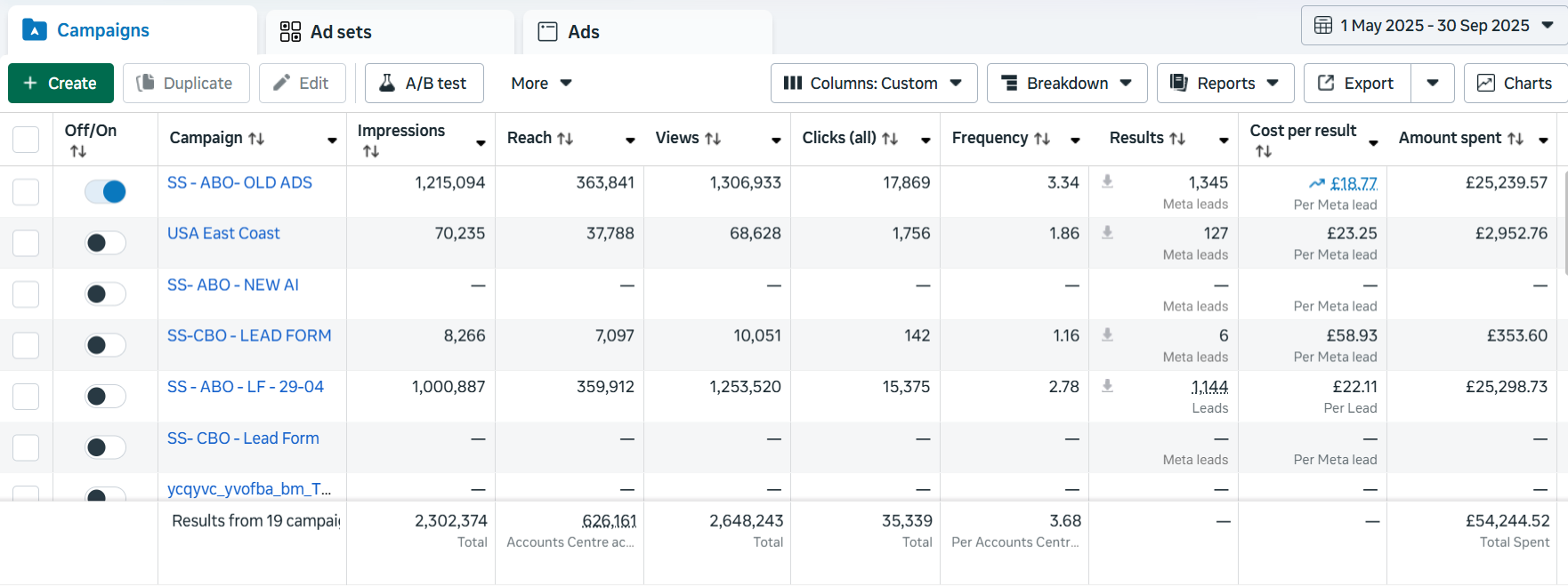
Across the reporting period, the campaign delivered 2.30M impressions, reached 626K people, and generated 2.62K Meta leads from £54.24K in spend—at an average cost per lead of £20.69. More importantly, the client gained a clearer system for understanding performance and making smarter growth decisions.
The work created a stronger paid-acquisition foundation: better lead tracking, tighter budget control, stronger creative learning, and a scalable approach to increasing lead volume without relying on guesswork.
Ready to build a growth system like this for your business?
Get Similar Results4. Facebook Ads Lead Generation Real Estate (India)
A real estate business needed a predictable lead generation system that could deliver high-quality leads at a controlled cost. We built a scalable acquisition funnel using Meta Ads, audience segmentation, creative testing, and conversion-focused lead form optimization.
The Business Situation
The client was operating in a highly competitive real estate market where buyers compare location, pricing, project credibility, amenities, and availability before showing interest. The business needed a steady pipeline of leads that the sales team could follow up with consistently.
Previous campaigns were generating leads, but the quality and cost efficiency were inconsistent. High cost per lead made scaling difficult, and unqualified inquiries created pressure on the sales process.
Our first priority was to build a structured performance system focused on high-intent lead generation, stronger audience targeting, better creative testing, and improved lead form conversion.
Key Problems Identified
- Highly competitive real estate market increased advertising costs.
- High cost per lead was affecting campaign profitability.
- Lead quality was inconsistent, with many unqualified inquiries.
- Campaigns did not always deliver a predictable lead flow.
- Audience targeting needed stronger segmentation by location and intent.
- The funnel needed better creative testing and lead form optimization.
Our Growth Process
Campaign Audit and Lead Quality Review
We began by reviewing the existing Meta Ads campaigns, audience targeting, lead forms, creatives, and lead quality. The goal was to understand where budget was being spent and which campaigns were producing usable inquiries for the sales team.
Instead of judging performance only by lead volume, we focused on cost per lead, lead quality, campaign consistency, and the ability to generate scalable inquiries.
Structured Meta Ads Funnel
We built a structured Meta Ads funnel using lead generation campaigns and retargeting. This helped separate cold audience acquisition from warmer prospects who had already interacted with the brand or shown interest.
The funnel made campaign decisions clearer and allowed budget to be allocated toward audiences and ad sets that delivered lower CPL and stronger lead potential.
Geo-Targeting and Audience Segmentation
We refined targeting using location-based segmentation, buyer intent signals, and audience testing. This helped the campaigns reach people more likely to be interested in the real estate offer.
By narrowing wasted reach and improving audience relevance, the campaigns became more efficient and better aligned with the client’s sales goals.
Creative and Lead Form Optimization
We tested multiple ad creatives, including video and static formats, to identify which messages attracted better-quality leads. The messaging was improved to communicate the offer more clearly and qualify interest before submission.
Lead forms were also optimized to improve conversion rates while maintaining lead quality, helping reduce unnecessary friction without attracting irrelevant inquiries.
Budget Allocation Based on CPL Performance
Budget was shifted toward campaigns and audiences producing lower cost per lead and more consistent lead flow. We avoided broad scaling and instead increased spend where the data showed stronger efficiency.
This helped the client generate leads at scale while maintaining better control over acquisition cost and campaign consistency.
Execution Focus
The project was handled as a complete lead generation system rather than a simple campaign launch. We connected campaign structure, targeting, creative testing, lead form performance, and sales pipeline needs.
Every optimization was reviewed through a performance lens: whether it helped reduce CPL, improve lead quality, increase consistency, or create a more predictable acquisition system.
What Changed for the Client
- The client gained a more predictable and scalable lead generation system.
- Cost per lead was reduced significantly through campaign optimization.
- Lead quality and conversion potential improved through better messaging.
- The sales team received a more consistent pipeline of inquiries.
- Budget allocation became more focused on low-CPL campaigns.
From inconsistent lead flow to a scalable real estate acquisition system.
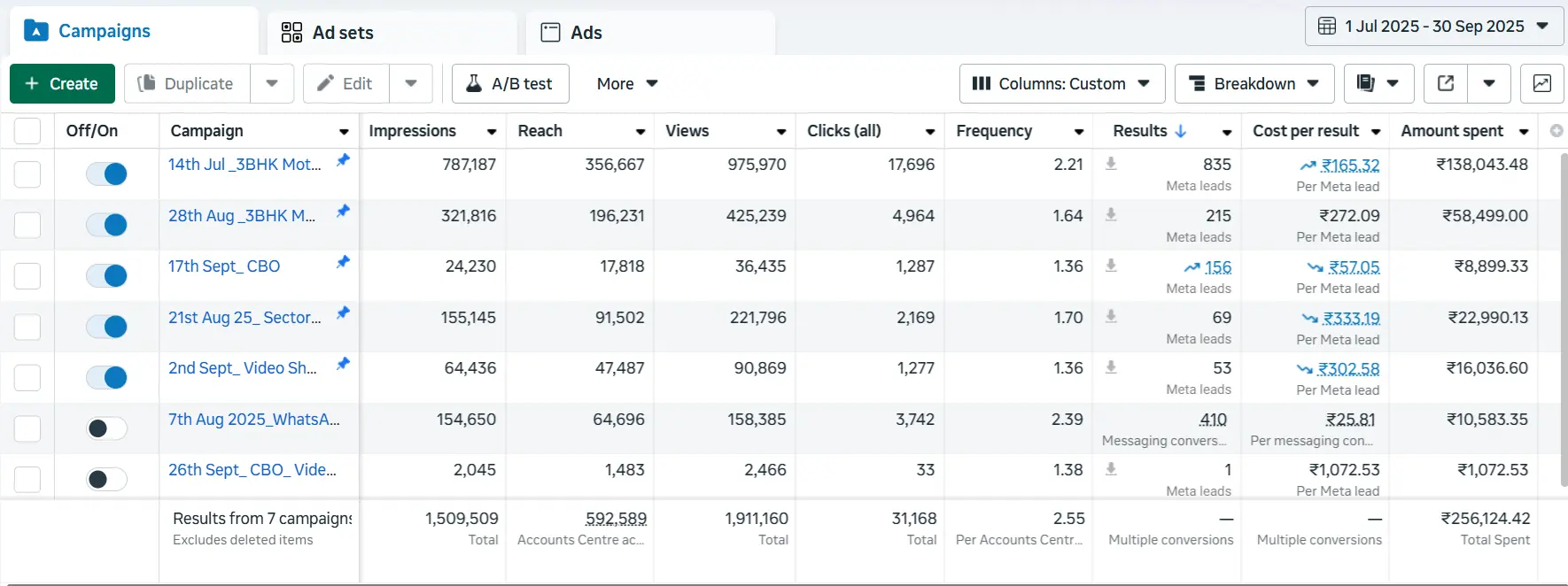
The campaigns managed ₹2.56L+ in ad spend, generated 1,700+ leads, and achieved a lowest CPL of ₹25.81 while maintaining consistent lead flow across campaigns.
The work created a stronger lead generation foundation: structured Meta Ads funnels, better geo-targeting, improved creatives, optimized lead forms, and a clearer system for scaling campaigns efficiently.
Ready to build a real estate lead generation system like this for your business?
Get Similar Results5. Facebook Ads Lead Generation - Home Improvement (USA)
A home improvement service business needed a scalable lead generation system that could deliver qualified homeowner inquiries across competitive local markets. We built a structured Facebook Ads strategy with geo-targeted campaigns, optimized lead forms, creative testing, and controlled budget scaling.
The Business Situation
The client was operating in a competitive home improvement market where homeowners compare service quality, pricing, trust, availability, and past work before submitting an inquiry. The business needed a reliable way to generate consistent service leads across multiple regions.
Campaigns were producing activity, but lead volume and quality were not stable across service areas. Rising cost per lead made scaling difficult, especially when inquiries were not always qualified or ready to book.
Our first priority was to create a structured lead generation foundation: cleaner campaign setup, stronger geo-targeting, improved lead forms, better creative testing, and controlled CPL-focused scaling.
Key Problems Identified
- High competition in local home service markets increased acquisition costs.
- Cost per lead was rising across multiple regions and service areas.
- Some inquiries were low-quality or not ready for a service booking.
- Lead volume was inconsistent across campaigns and locations.
- Audience targeting needed better segmentation around homeowner intent.
- The account needed a stronger scaling system while keeping CPL controlled.
Our Growth Process
Campaign Audit and Market Review
We began by reviewing the Facebook Ads account, campaign structure, targeting, lead forms, creatives, service areas, and cost per lead trends. The goal was to understand which campaigns were driving useful inquiries and where budget was being wasted.
This helped us separate high-potential service areas from weaker traffic sources and build a clearer plan for improving lead quality while maintaining volume.
Structured Campaign Setup
We built a structured campaign system using ABO, CBO, and remarketing campaigns. Each campaign had a clear role, from testing audiences and creatives to scaling proven ad sets and re-engaging interested prospects.
This structure made it easier to control spend, compare performance, and scale campaigns without losing visibility on CPL and lead quality.
Geo-Targeting and Audience Segmentation
We created geo-targeted campaigns based on the client’s service areas and segmented audiences around homeowner intent. This helped the ads reach people more likely to need home improvement services.
By improving local targeting and audience relevance, we reduced wasted reach and increased the chances of generating qualified inquiries.
Creative and Funnel Optimization
We tested multiple creative angles, including before-and-after visuals, service highlights, and benefit-focused messaging. The goal was to attract serious homeowners and communicate the value of the service clearly.
Lead forms were optimized to improve conversion rates while filtering for better-quality inquiries, helping the sales team receive more relevant prospects.
Scaling High-Performing Ad Sets
Once strong patterns appeared, we scaled high-performing ad sets while monitoring CPL, click volume, and lead quality. Budget was not increased blindly; it was directed toward campaigns that showed consistent efficiency.
This helped the client increase lead volume while maintaining a more stable cost per lead across campaigns.
Execution Focus
The project was managed as a complete lead generation system rather than a basic ad setup. We connected targeting, campaign structure, creative performance, lead form quality, and service area demand.
Every optimization was reviewed through a practical lens: whether it helped reduce wasted spend, improve lead quality, stabilize CPL, or create a more predictable pipeline for service bookings.
What Changed for the Client
- The client gained a scalable and consistent lead generation system.
- Lead quality improved through better targeting and messaging.
- Wasted spend was reduced across weaker audiences and service areas.
- CPL stayed more stable while lead volume increased.
- The business built a more predictable pipeline for service bookings.
From inconsistent inquiries to a scalable home services lead system.
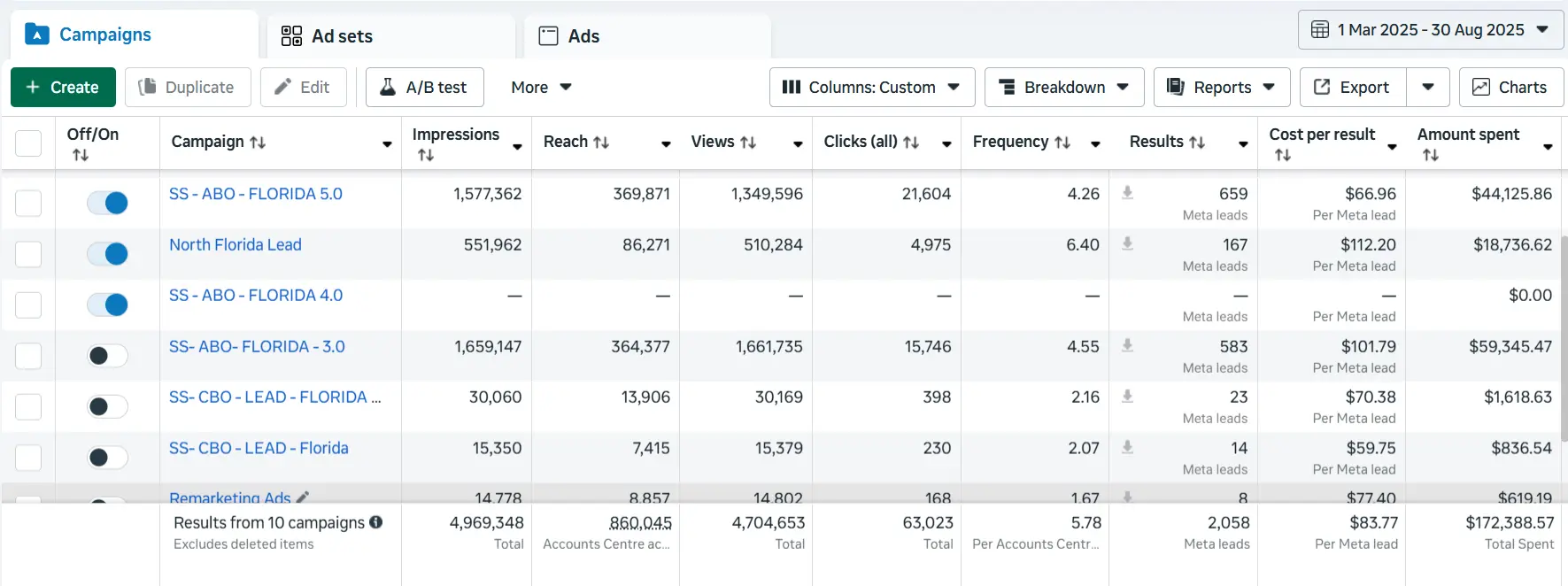
The campaigns managed $172K+ in ad spend, generated 2,000+ leads, achieved an average CPL of around $83.77, and drove 63K+ clicks across campaigns.
The work created a stronger acquisition foundation: structured Facebook Ads campaigns, better geo-targeting, improved creative testing, optimized lead forms, and a clearer system for scaling qualified homeowner inquiries.
Ready to build a home improvement lead generation system like this for your business?
Get Similar Results6. Google Ads Lead Generation - Education & Training (India)
An education and training centre needed a consistent way to turn high-intent course searches into quality enquiries. We refined its Google Ads lead-generation system with sharper keyword strategy, cleaner campaign structure, conversion tracking, and landing-page optimisation to create an efficient enrolment pipeline.
The Business Situation
The client operates in the competitive education and training sector, where prospective learners compare course relevance, outcomes, schedules, fees, and credibility before submitting an enquiry. Search demand existed, but the account needed a clearer system for connecting high-intent queries with measurable conversion volume.
Budget was being used across a range of course-related searches, while intent varied significantly by programme, location, and stage of decision-making. Scaling without a more controlled structure risked spending more on research-driven clicks that did not translate into quality learner enquiries.
Our priority was to build a reliable acquisition foundation: accurate conversion tracking, clearer campaign roles, stronger keyword intent signals, and a low-friction path from course discovery to enquiry submission.
Key Problems Identified
- Campaigns needed clearer separation by course category, location, and learner intent.
- Budget was reaching search traffic that did not consistently progress to an enquiry.
- Conversion tracking and reporting needed validation so optimisation decisions could be trusted.
- Ads and landing pages needed clearer course outcomes, trust signals, and stronger calls to action.
- There was no consistent framework for deciding which courses and keywords deserved more budget.
- The account needed controlled scaling rather than broad budget increases across every campaign.
Our Growth Process
Performance Audit and Tracking Review
We began by auditing the Google Ads account, conversion actions, search terms, keywords, landing pages, and enquiry journey. The objective was to identify unclear performance data and spending that was not producing enough valuable learner enquiries.
This helped us separate real growth opportunities from surface-level traffic numbers. Instead of looking only at clicks or impressions, we focused on conversions, cost per conversion, lead quality, and scale.
Campaign and Keyword Structure Rebuild
We rebuilt the account across clear Search, campaign, and ad-group layers so every campaign had a defined role. Keywords were organised around course relevance and intent, while budget was directed towards the search themes creating efficient conversion volume.
This structure made it easier to control budgets, compare performance, and understand which parts of the account were actually contributing to enquiries.
Search Intent and Ad Message Optimisation
We reviewed search terms, keyword performance, ad copy, and learner behaviour to identify where prospects showed the strongest intent. High-value course queries received more attention, while irrelevant searches and low-performing areas were reduced.
This improved budget efficiency because spend was redirected toward course searches and messages more likely to produce qualified enquiries at a sustainable cost.
Landing Page and Enquiry Journey Optimisation
Paid search performs best when the conversion experience makes responding easy. We reviewed landing-page clarity, course information, trust signals, mobile usability, forms, and calls to action to remove friction between the ad click and the enquiry.
The focus was to make it easy for prospective learners to understand the course, trust the centre, and submit their details without unnecessary steps or confusion.
Budget Scaling With CPA Control
Once the account showed stable conversion patterns, we scaled budgets gradually. We did not scale every campaign equally. Budget increases were based on conversion volume, cost per conversion, keyword quality, and course-level demand.
This helped the client grow enquiry volume while maintaining control over efficiency and reducing the risk of overspending on weak keywords or low-intent traffic.
Execution Focus
The project was handled as a complete performance system rather than a simple ad campaign setup. We connected campaign decisions with search behaviour, keyword performance, and real enquiry outcomes.
Every optimisation was reviewed through a commercial lens: whether it helped reduce wasted spend, improve lead quality, lower cost per conversion, or make scale more predictable.
What Changed for the Client
- The client gained better clarity on which campaigns, keywords, and courses were driving enquiries.
- Budget allocation became more strategic instead of being spread too broadly.
- The enquiry journey became more aligned with learner research and mobile expectations.
- Campaign performance became easier to measure, manage, and improve over time.
- The business gained a stronger foundation for future scaling across paid channels.
From scattered search activity to a scalable education lead-generation system.
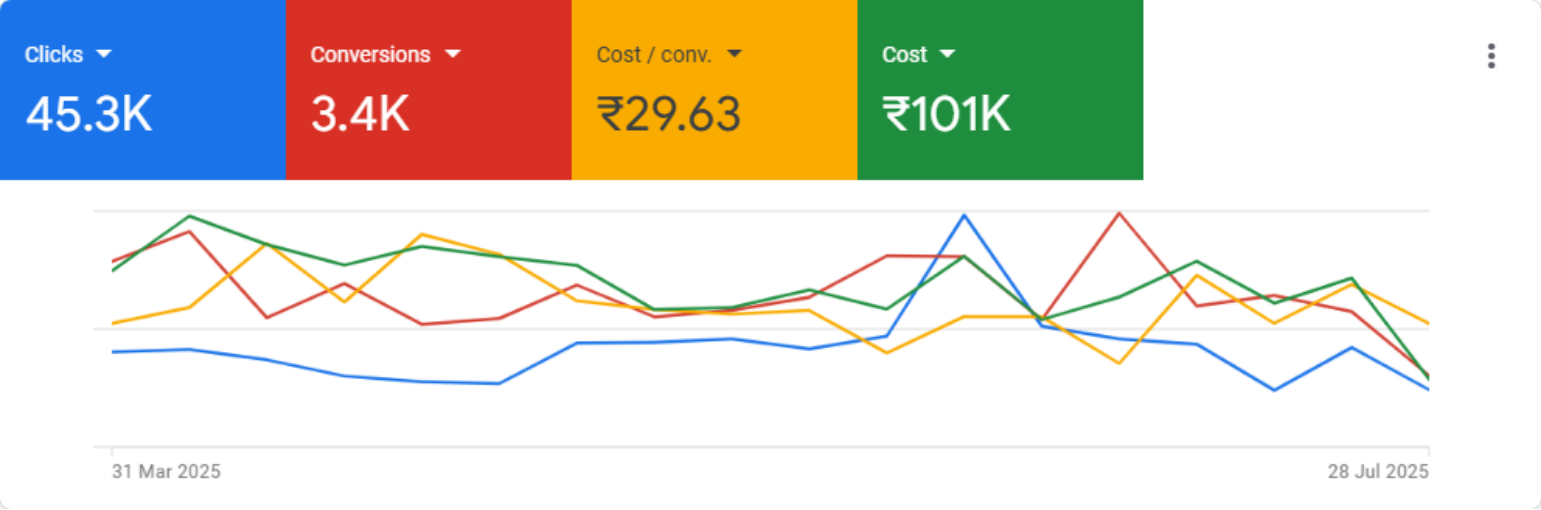
During the reporting period, the campaign generated 45.3K clicks and 3.4K conversions from ₹101K in spend, at an average cost per conversion of ₹29.63. More importantly, the client gained a clearer system for understanding performance and making smarter growth decisions.
The work created a stronger paid-acquisition foundation: better conversion tracking, tighter budget control, stronger keyword learning, and a scalable approach to increasing learner enquiries without relying on guesswork.
Ready to build a growth system like this for your business?
Get Similar Results7. Google Ads Lead Generation - Travel & Tourism (India)
A travel and tourism business needed a scalable acquisition system to reach high-intent travelers and booking-ready users. We built structured Google Ads campaigns focused on destination searches, package queries, seasonal demand, and conversion-focused landing page improvements.
The Business Situation
The client was operating in a competitive travel and tourism market where users compare destinations, packages, pricing, itineraries, availability, and trust before making an inquiry or booking.
Campaigns needed to capture users with real travel intent while avoiding spend on low-quality traffic. Seasonal demand shifts also made performance unstable, especially when search behavior changed across different travel periods.
Our first priority was to create a reliable booking-focused growth system using structured campaigns, intent-based keywords, accurate conversion tracking, and landing page optimization.
Key Problems Identified
- Travel keywords were highly competitive with rising CPC.
- Seasonal fluctuations were affecting campaign stability.
- Non-intent traffic was reducing conversion efficiency.
- High-value booking audiences were difficult to capture consistently.
- Landing pages needed a smoother booking experience.
- Tracking and testing needed to support smarter optimization decisions.
Our Growth Process
Campaign Audit and Search Demand Review
We reviewed the Google Ads account, search behavior, keyword intent, destination demand, landing pages, and conversion tracking setup. The goal was to identify where traffic quality was strong and where budget was being spent on low-intent users.
This helped us focus campaign decisions on conversions, cost per conversion, booking intent, and seasonal demand patterns instead of only clicks or impressions.
Structured Google Ads Campaign Setup
We built a structured campaign system using Search and Performance Max. Search campaigns targeted high-intent destination and package queries, while Performance Max helped support broader discovery and remarketing opportunities.
This structure made it easier to manage budgets, compare campaign performance, and guide users from travel discovery toward booking action.
Intent-Based Keyword and Geo-Targeting
We focused on keywords that showed stronger booking intent, including destination searches, travel package queries, and service-specific terms. Geo-targeting was refined around regions that showed better conversion potential.
This improved traffic quality by reducing spend on broad informational searches and directing more budget toward users closer to making a travel decision.
Landing Page and Conversion Optimization
We optimized landing pages to create a smoother booking experience across desktop and mobile. Improvements focused on page speed, usability, package clarity, inquiry flow, and trust-building elements.
Accurate conversion tracking was also set up so campaign decisions could be based on real inquiry and booking actions rather than surface-level engagement.
Continuous Testing and Cost Control
We continuously tested ads, keywords, landing page elements, and campaign signals to improve conversion rates and reduce acquisition cost.
Budget was shifted toward campaigns and search terms that delivered stronger conversion volume at a more efficient cost per conversion.
Execution Focus
The project was managed as a full booking funnel rather than a simple traffic campaign. We connected search intent, campaign structure, landing page performance, seasonal demand, and conversion tracking.
Every optimization was reviewed through a growth lens: whether it helped improve conversion rates, reduce cost per conversion, attract booking-ready users, or create more predictable travel inquiries.
What Changed for the Client
- The client gained a scalable and consistent booking funnel.
- Conversion rates improved through intent-driven targeting.
- Cost per conversion was reduced with continuous optimization.
- High-intent travelers became easier to reach and convert.
- The business gained a more predictable system for leads and bookings.
From seasonal traffic uncertainty to a consistent travel booking funnel.
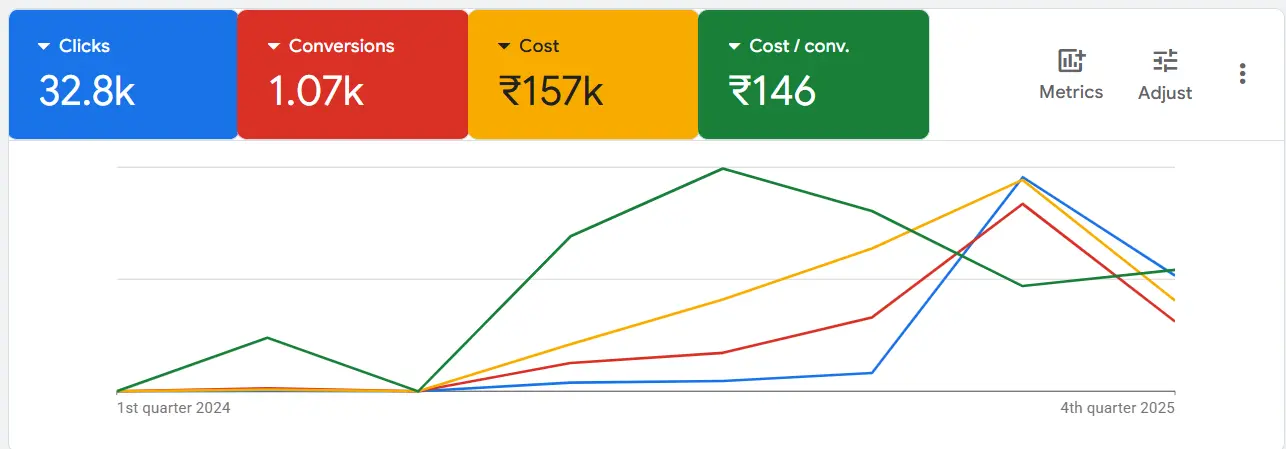
The campaigns generated 32.8K+ clicks, delivered 1.07K conversions, managed ₹157K in ad spend, and achieved a ₹146 cost per conversion.
The work created a stronger travel acquisition foundation: structured Google Ads campaigns, intent-based keyword targeting, improved landing pages, accurate tracking, and continuous testing for more predictable booking growth.
Ready to build a travel booking growth system like this for your business?
Get Similar Results8. B2B Manufacturing Lead Generation Growth (USA)
A B2B manufacturing business needed a reliable way to reach relevant decision-makers and generate measurable sales enquiries. We refined its LinkedIn Ads lead-generation system through clearer campaign structure, audience targeting, message testing, and lead-form optimisation to build a more predictable demand pipeline.
The Business Situation
The client operates in a complex B2B manufacturing environment, where buying decisions often involve technical requirements, multiple stakeholders, lengthy evaluation cycles, and a strong need for credibility. The account had reach potential, but needed a clearer system for connecting professional audiences with measurable leads.
Budget was being used across campaigns and audience segments with different levels of buying influence. Scaling without a controlled structure risked reaching broad professional audiences without creating enough meaningful engagement with the lead form or enough submitted enquiries.
Our priority was to build a reliable B2B acquisition foundation: accurate lead reporting, clearer campaign roles, relevant decision-maker targeting, and a low-friction path from ad engagement to lead-form completion.
Key Problems Identified
- Campaigns needed clearer separation by audience, manufacturing solution, and lead-generation objective.
- Budget could reach people with professional relevance but not necessarily active buying intent.
- Lead-form activity needed to be monitored beyond impressions to identify points of drop-off.
- Ad messaging needed to communicate technical relevance, commercial value, and credibility more clearly.
- There was no consistent framework for comparing campaign groups and allocating budget by lead efficiency.
- The account needed controlled scaling rather than broad increases across all campaign groups.
Our Growth Process
Performance Audit and Tracking Review
We began by auditing the LinkedIn Ads account, campaign groups, lead-form setup, audience targeting, creative, and reporting. The objective was to identify unclear performance data and spending that was not producing enough valuable B2B lead activity.
This helped us separate real growth opportunities from surface-level traffic numbers. Instead of looking only at clicks or impressions, we focused on lead-form opens, submitted leads, completion rate, cost per lead, and scale.
Campaign and Audience Structure Rebuild
We rebuilt the account across clear campaign groups so every campaign had a defined role. Audiences were organised around relevant industries, functions, seniority, and decision-making context, while budget was directed towards the groups creating efficient lead volume.
This structure made it easier to control budgets, compare performance, and understand which parts of the account were actually contributing to submitted leads.
B2B Message and Creative Optimisation
We reviewed ad messages, creative, campaign group performance, and form behaviour to identify where target professionals showed the strongest engagement. Stronger solution-led concepts received more attention, while low-performing messages and weak audience combinations were reduced.
This improved budget efficiency because spend was redirected toward messages and professional audiences more likely to produce B2B leads at a sustainable cost.
Lead Form and Enquiry Journey Optimisation
LinkedIn Ads performs best when the conversion experience makes responding easy. We reviewed lead-form questions, offer clarity, trust signals, calls to action, and the follow-up journey to remove friction between ad engagement and form completion.
The focus was to make it easy for relevant decision-makers to understand the offer, trust the business, and submit their details without unnecessary steps or confusion.
Budget Scaling With CPL Control
Once the account showed stable lead patterns, we scaled budgets gradually. We did not scale every campaign equally. Budget increases were based on lead volume, cost per lead, lead-form completion rate, and campaign group performance.
This helped the client grow B2B lead volume while maintaining control over efficiency and reducing the risk of overspending on low-performing audiences or weak campaign groups.
Execution Focus
The project was handled as a complete performance system rather than a simple ad campaign setup. We connected campaign decisions with professional audience behaviour, lead-form engagement, and real B2B lead outcomes.
Every optimisation was reviewed through a commercial lens: whether it helped reduce wasted spend, improve lead quality, maintain cost per lead, or make scale more predictable.
What Changed for the Client
- The client gained better clarity on which campaigns, audience groups, and messages were driving leads.
- Budget allocation became more strategic instead of being spread too broadly.
- The lead journey became more aligned with professional research and B2B decision-making expectations.
- Campaign performance became easier to measure, manage, and improve over time.
- The business gained a stronger foundation for future scaling across paid channels.
From broad professional reach to a scalable B2B manufacturing lead-generation system.
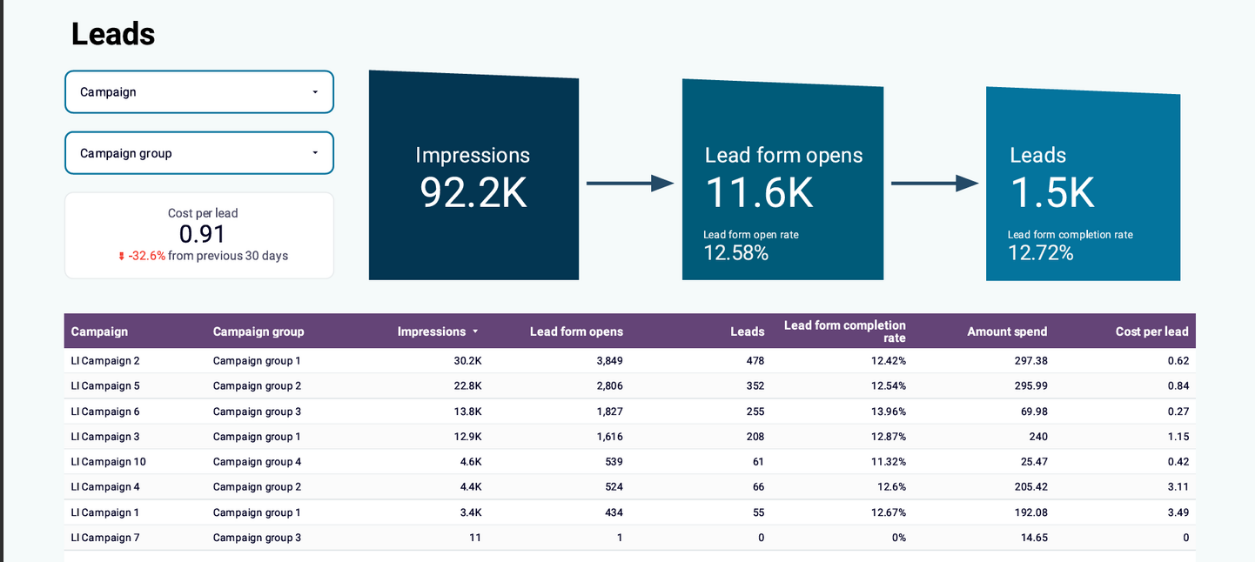
During the reporting period, the campaign delivered 92.2K impressions, generated 11.6K lead-form opens, and produced 1.5K leads. The dashboard reported a 12.58% lead-form open rate, a 12.72% completion rate, and a cost per lead of $0.91 USD. More importantly, the client gained a clearer system for understanding performance and making smarter growth decisions.
The work created a stronger B2B paid-acquisition foundation: better lead reporting, tighter budget control, stronger audience and message learning, and a scalable approach to increasing qualified enquiries without relying on guesswork.
Ready to build a growth system like this for your business?
Get Similar Results